
Missile Defense Agency: Efficient Test & Evaluation (T&E) via Adaptive Sampling Simulation Optimization
Request a Meeting
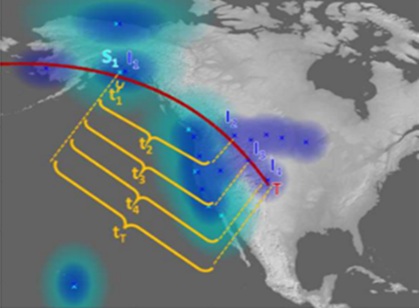
Challenge
The MDA needs to generate “heatmap” (response surface) analyses to understand the effectiveness of the Missile Defense System across a wide range of scenarios. Traditional approaches, like full enumeration or dense sampling, would require orders of magnitude more simulation runs than are computationally feasible.
Our Solution
We developed and integrated a novel adaptive sampling engine into our OptDef software. This engine uses a specially adapted Kriging algorithm to intelligently select the most informative simulation runs to execute based on an estimate of the response surface and its variance. We further enhanced this with Difference Kriging, which uses results from previous studies to dramatically accelerate new, similar analyses.
Impact
Our solution enabled the generation of high-quality response surfaces with vastly fewer simulation runs compared to competing methods. This saves MDA significant time and computational resources while maximizing the information gained from their valuable high-fidelity models.
More Case Studies
Rapid Calibration of AI Models to High-Fidelity Benchmarks
High-fidelity, physics-based simulations (e.g., 6DOF trajectory models) are often too slow for large-scale analysis. Faster AI-based surrogate models are needed, but they must be accurately calibrated to match the “truth” performance of the accredited high-fidelity model.
U.S. Navy: Optimizing Hypersonic Weapon Performance
The U.S. Navy is working to rapidly develop and field hypersonic weapons, a process which requires analyzing a vast and complex parameter space to improve the Probability of Arrival (PA) and the Probability of Kill (Pk) of these new weapons.